
What to know about Temporary Denerators and the Rights around them?
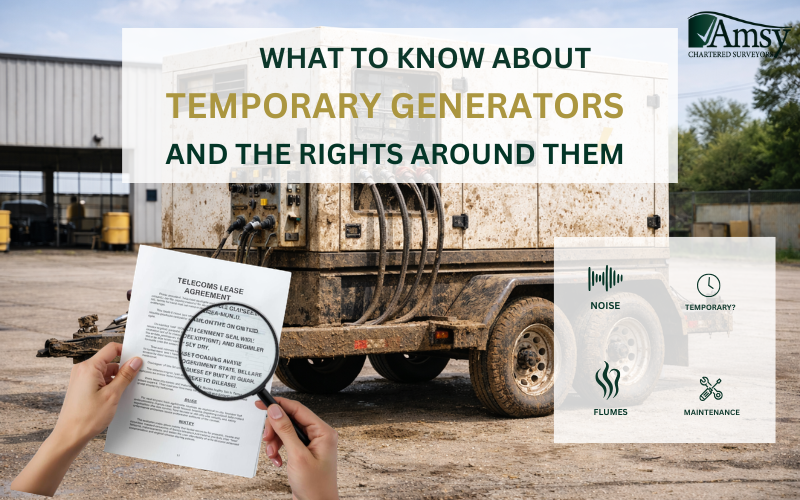
One of the common ‘Operator rights’ seen in telecommunication leases permits the Operator use of temporary generators when necessary.
There are several considerations every site provider should be considering when Operators advise their intention to install a temporary generator.
Why is a Temporary Generator Even Needed
Before outlining considerations for the site provider, it would be helpful to understand why Operators would ever need a temporary generator. Reasons would include (but not only);
- The power required cannot be met by the building’s current power supply. This could be due to building works which have altered power capacity.
- Damage to the power supply which now has reduced capacity or not functioning all together.
The above issues can normally be fixed in relative short amounts of time but in the interim the Operators will want to install a temporary generator.
Below are some of the factors all site providers should consider.
Noise regulations.
Generators are ‘noise producing machines’. Noise regulations can be complicated due to the rules around acceptable noise differing between councils to Local Authorities. A site provider should check local regulations online or talk directly with the Local Authorities.
Having checked many of the local authorities’ regulations, below are a few pointers that Local Authorities tend to follow and Operators may contravene.
- Sound measurement spectrum – Although, sound is often measured in decibels, the local authorities will often use A-weighted decibels (dBA) that is more in line with the human ear. (Want to have a rough idea of the scale of sound? Follow this link to the examples of noise levels.)
- Zoned areas – You will need to know if the generator is in a zoned area; notably, the regulations normally only apply to residential and commercial zones.Regulations pertaining to sound levels will vary depending on the time. During daytime hours, generator noise is permitted to be up to 10 dBA above the established baseline background noise of the area. At night, however, generator noise must not exceed the baseline background noise level. You would be surprised how many generators are exceeding permitted levels.
How often should the generator be serviced?
It is generally recommended that actively used diesel generators be serviced every 200-250 hours, equivalent to approximately 8 to 10 days. If a temporary generator has been installed on your premises by an operator, ensure that this maintenance is performed accordingly. Regular servicing is essential to maintaining optimal performance; neglecting it can result in increased noise levels, higher levels of dirt and debris buildup, reduced efficiency, and more frequent operation.
It is also important to remember when the Operators need to come and service the generator, always, make sure that the engineers are verified and fully certified.
What should you do if the fumes are causing issues?
First, ensure that any complaints are documented in writing. Then, submit these to your designated agent or directly to your Operator contact. While removal of the generator is not mandatory, presenting documented concerns may incentivize a more timely resolution. This could include relocating or servicing the generator, which will be arranged as necessary.
Have you ask if alternative power sources have been looked into?
Currently, the use of alternative power sources remains relatively uncommon, though there have been instances of solar and wind energy being implemented in more remote areas. The growing emphasis on environmentally sustainable solutions has led to an increased availability of options such as solar, wind, and hydrogen generators. Given that operating diesel generators can be costly, exploring these alternative energy sources presents a potentially less intrusive and more economical solution for power generation.
What does temporary mean?
The term “temporary” can be somewhat ambiguous. Operators will inform you that it refers to the duration of their exploration of solutions. While this is generally accurate, it will only work for so long; it depends on the issue. I would suggest engaging your agent right way. They also often specify that a wayleave for electricity should typically take around six weeks. Given this, the most effective use of the term “temporary” is to encourage the Operator to expedite their resolution process.
Do you know what your lease says?
Lease terms regarding temporary generators vary significantly. It is important to review your lease agreement to understand what is permitted. Some leases may specify limitations on the duration of generator placement, include associated costs, or prohibit their use entirely. Also, a lease plan should be reviewed as that will often dictate a specific demised area for the generator.
Additionally, if the lease does not explicitly mention temporary generators, it generally indicates that the installation of such equipment is not authorised.
Examples of noise levels
Decibel (dB or dBA) measurement quantifies sound intensity and its potential impact on auditory health. The pain threshold typically exceeds 115 dBA, where acute hearing damage can occur rapidly. Below are standardized decibel levels corresponding to specific environmental sound sources:| Decibel Level | Description |
|---|---|
| 190 dBA | Represents peak sound levels associated with proximity to high-impulse weapons fire, such as heavy artillery, exceeding discomfort thresholds. |
| 180 dBA | Equivalent to discharge of a toy pistol near the ear, at the upper limit of safe noise exposure. |
| 160 dBA | The acoustic energy generated by a hammer impacting brass tubing or steel plate from a 1-meter distance. |
| 150 dBA | The sound intensity experienced during smithy hammering at approximately 5 meters, near maximum permissible exposure. |
| 130 dBA | Comparable to hand clapping 1 meter from the observer, approaching maximal safe exposure levels. |
| 120 dBA | Pertains to whistle sounds at 1 meter or jet engine run-up at 15 meters, within high risk zones. |
| 115 dBA | The noise level during aircraft take-off at around 10 meters distance. |
| 95 dBA | Elevated ambient noise, such as loud crying or a hand-held circular saw operating at 1 meter. |
| 90 dBA | Similar in loudness to a petrol-powered lawnmower during operation. |
| 80 dBA | Traffic noise from passing lorries at 7.5 meters or high-volume urban traffic at 25 meters. |
| 70 dBA | Noise levels typical of busy urban roads during daytime or a quiet hair dryer at 1 meter. |
| 65 dBA | Normal conversational speech. |
| 50 dBA | Environmental noise like a refrigerator at 1 meter or bird vocalizations heard from 15 meters. |
| 45 dBA | Typical indoor ambient noise, including conversations or background radio/music. |
| 25 dBA | Breathing sounds detected at 1 meter. |
| 0 dBA | The established threshold of human audibility, representing the quietest perceivable sound. |
Should you have any further queries or if you‘re Site Provider dealing with any temporary generator issues, please be in contact with Amsy Surveyors who will be able to assist